Every concrete pour tells a story that started long before the truck showed up, and the wrong machine at any chapter can cost a contractor a day, a budget, or a callback. At Arvada Rent-Alls, we’ve been outfitting Denver-area crews since 1963, and one of the most common conversations we have at the counter is contractors realizing, usually the morning of the pour, that they grabbed the wrong tool for the phase they’re actually in. A plate tamper isn’t a trench roller. A 14-inch saw isn’t a wall saw. And mixing a slab’s worth of concrete by hand because you assumed a wheelbarrow would do it is a long, ugly day.
This guide walks through the job in order, from breaking ground to finishing the slab, and matches the right compaction and concrete equipment to each stage. Use it as a checklist before you load the trailer.
Stage 1: Site Prep and Subgrade Work
Before anything gets poured, the dirt has to be right. Subgrade work means clearing the area, cutting to grade, and getting that first layer of soil tight enough to support whatever’s going on top of it. On the Front Range, you’re often dealing with expansive clay, decomposed granite, or pockets of fill, none of which forgive shortcuts.
Hand Tamper: For small spot fixes around fence posts, footings, and tight corners where powered equipment doesn’t make sense.
Wacker WP 1550 Plate Tamper: The workhorse for sidewalks, patios, and small slab subgrades. Best on granular soils like sand and gravel.
Reversible Plate Tamper 900 lbs: Step up here when you need deeper compaction on bigger flatwork or driveway subgrades. The reversible feature also saves you from making three-point turns in tight spots.
Why it matters: Skip or short this stage, and you’re building on something that will move. Compact in 4- to 8-inch lifts, not all at once.
Stage 2: Trench Compaction
Utility trenches, footings, and any backfill in a confined space are their own world. A plate tamper can’t reach down a 4-foot trench, and trying to compact a backfilled trench from the top with a roller is a waste of fuel. This is where narrow, high-impact tools earn their rent.
Bomag BT60/4 Jumping Jack Tamper: The standard gas-powered rammer for cohesive soils like clay and silty backfill, anything that needs to be punched, not pressed. Ideal for utility trenches and pipe bedding.
120V Electric Jumping Jack or Battery-Powered Jumping Jack: When you’re working indoors, in a basement, or anywhere fumes are a problem, these deliver the same impact without exhaust.
Sheepsfoot Trench Compactor (Bomag): For longer, wider trenches and pipeline backfill. The pad-foot drum kneads cohesive soils far better than a smooth drum ever will.
Tip: Compact backfill in 6 to 8-inch lifts. Dumping the whole trench full and trying to compact it from the top doesn’t work. The bottom stays loose, and your pipe settles.
Stage 3: Sub-Base and Base Course Compaction
Once the subgrade is locked in, the base course goes down. This is the layer that actually distributes the load. Get it tight, or your slab cracks where the base failed.
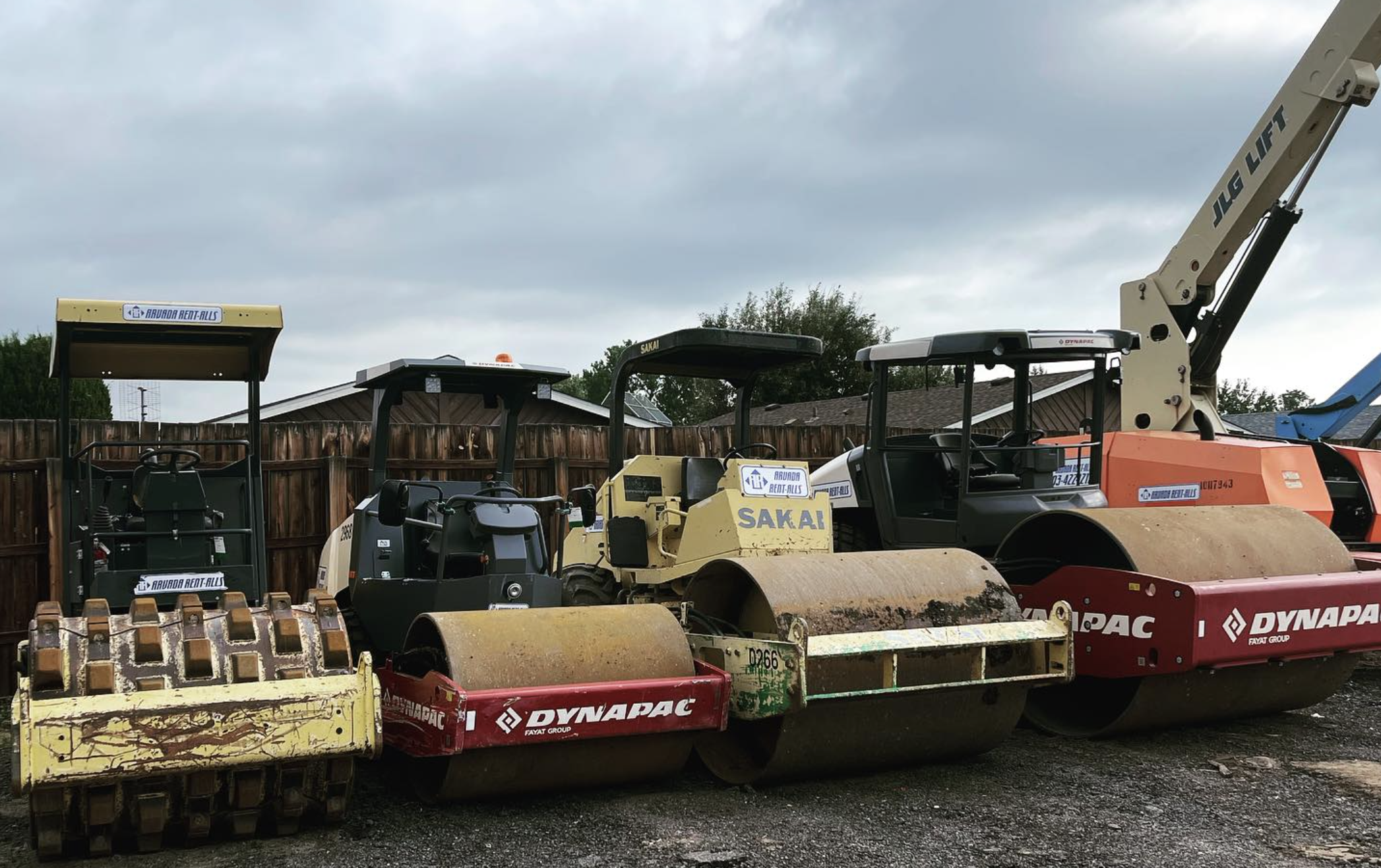
Roller, Smooth Drum (Bomag): Walk-behind smooth drum that handles driveways, parking pads, and mid-sized flatwork base prep.
Single Drum Roller 54″, 66″, and 84″: Step the drum width up to match the area. The 54″ is plenty for residential driveways and small lots; the 84″ earns its keep on parking lots, roadwork, and large pads. Vibratory mode penetrates deeper on a granular base; static is gentler on softer subgrades.
Tip: Always overlap each pass by at least 6 inches and count your passes. Most base courses need 4 to 6 passes to hit spec. If you’re unsure, get a density test before you pour.
Stage 4: Mixing and Placing Concrete
For small pours, repair work, or sites where a ready-mix truck can’t reach, you’re mixing on site. The right mixer is the one that matches your batch size. Too small and you’re mixing all day; too big and you’re wasting yardage you can’t place fast enough.
3 Cubic Foot Electric Mixer: Great for repair work, post setting, small footings, and patch jobs.
9 Cubic Foot Gas Tow-Behind Mixer: When you’ve got real volume to move and no power on site. Tow it to the work area, mix in the field.
Mortar Mixer (6 and 9 cu. ft. Stone): Built specifically for mortar and stucco. The paddle action handles those mixes better than a drum mixer.
MudMixer: Continuous mixer for crews who need consistent output without stopping to load each batch.
For placement, especially when the truck can’t back up to the form:
Concrete Power Buggy and Rubber Track Power Buggy: Move yards of concrete fast across rough ground, through gates, and around landscaping. The track version handles soft or muddy site conditions that the wheeled buggy struggles with.
Wheelbarrow: Still the right call for short hauls and patchwork. We rent them by the day.
Tip: Always have one more wheelbarrow or buggy than you think you need. The pour doesn’t wait for you.
Stage 5: Consolidation
Once the concrete is in the form, you’re fighting trapped air. Air pockets weaken the slab, leave honeycomb on the surface, and ruin the finish.
Wacker Concrete Vibrator: Insert the head vertically, hold it until the bubbles stop rising, and pull it out smoothly. Don’t drag it sideways. That segregates the mix.
Tip: Over-vibrating is just as bad as under-vibrating. Five to fifteen seconds per insertion in most slabs is plenty. Watch for the moment the surface goes glossy, and the coarse aggregate stops rising.
Stage 6: Finishing the Slab
This is where the work shows. A poorly finished slab telegraphs every mistake from the previous stages, but a good finish can rescue an average pour.
Bartell Terex Power Trowel: Walk-behind trowel for slabs once the concrete has set up enough to walk on without leaving a deep footprint (usually a 1/4″ indent or less). Float blades first to bring the cream up, then switch to finish blades to achieve a burnished surface.
Tip: Timing is everything. Trowel too early and you trap bleed water; too late and the surface is too hard to work. Watch the slab, not the clock.
Stage 7: Cutting Control Joints
Concrete will crack. The question is whether you control where it cracks. Control joints, cut at the right depth and the right time, give the slab a planned place to relieve stress.
14″ Gas Walk-Behind Concrete Saw: The everyday saw for control joints in residential and light commercial slabs.
18″ Gas Walk-Behind Concrete Saw: When the slab is thicker, or you’re cutting deeper joints.
Husqvarna K3000 Cut-N-Break Wall Saw: For cutting openings in existing walls or thicker structural concrete.
Gas Stihl Demolition Saw or 120V Electric Wet Demolition Saw: Handheld cuts for trim work, doorways, and repair cuts.
Tip: Cut joints between 6 and 18 hours after the pour, before the slab cracks on its own. Joint depth should be at least 1/4 of the slab thickness.
Stage 8: Surface Prep, Repair, and Modifications
Whether you’re prepping an existing slab for an overlay, smoothing a high spot, or running a new utility line through a finished floor, the right surface tool keeps the work clean.
7″ Floor Grinder and EDCO Single Disc Grinder: Surface prep for coatings, removing thinset or paint, smoothing trip hazards.
5″ Diamond Grinder: Handheld work, edges, corners, and detail grinding.
3-Head Pneumatic Scabbler: Aggressive surface removal when you need to take the slab down to clean concrete for a bonded overlay.
Handheld Electric Core Drill and Stand-Style Electric Core Drill: Clean, precise holes for plumbing, conduit, anchor bolts, and HVAC penetrations. Use the stand model for anything over 2 inches or for repeated holes. The precision is worth it.
Plan the Job Backward
The best contractors we work with don’t pick equipment one job at a time. They pick it one phase at a time. Walk the job in your head from finished slab back to bare dirt, list the machine you need for each stage, and call us before the morning of. We can hold equipment, deliver it to your site, and make sure you’re not standing in the yard at 6 a.m. realizing the jumping jack isn’t a substitute for a trench roller.
Ready to line up the right equipment for your next pour? Contact Arvada Rent-Alls at our Arvada location (303-422-1212) or our Littleton location (303-979-4810), or browse the full lineup of compaction equipment and concrete and brick equipment online. We’ll help you get every stage right.
Monday through Saturday
7 AM to 5 PM
(Closed Sundays throughout the year)
Built by Twelve Legs Marketing © 2026 | Privacy Policy